Machines with Soul: How Funk Producers Turned Circuits and Chips Into Pure Groove
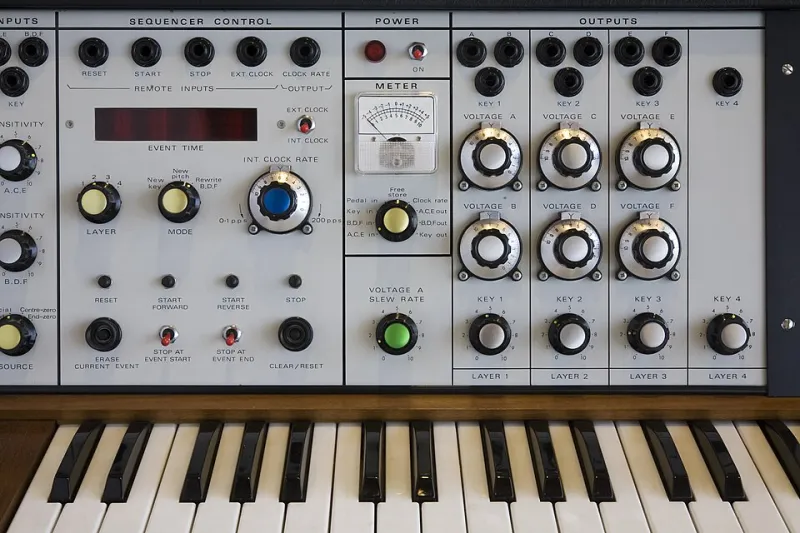
Photo: Jorge Royan, CC BY-SA 3.0, via Wikimedia Commons
Somewhere around 1977, a quiet argument was happening inside recording studios all across America. On one side: the purists who believed funk lived and died on the sweat of live musicians locked in a room together. On the other: a new breed of producer who looked at a synthesizer and heard possibilities that no horn section could ever deliver. The purists weren't wrong. But neither were the producers reaching for those knobs.
What followed was one of the most exciting sonic experiments in American music history — and most people don't even know it happened.
The Gear That Changed Everything
Let's talk about the hardware for a second, because you can't tell this story without it.
The Minimoog synthesizer showed up in the early '70s and immediately started causing trouble in the best possible way. It was portable, it was relatively affordable compared to the room-sized modular monsters that came before it, and it could produce a bass tone that rattled your chest from twenty feet away. Funk producers didn't need much more convincing than that.
Then came the Roland TR-808 drum machine in 1980 — arguably the single most influential piece of equipment in the history of Black American music. It was actually considered a commercial failure at first. Roland discontinued it pretty quickly. But producers like Roger Troutman and Sly Stone had already figured out that the 808's booming, synthetic kick drum and its crisp, almost alien hi-hats were a different kind of rhythm section altogether. Not a replacement. A reinvention.
The Oberheim DMX, the LinnDrum, the Yamaha DX7 — each one landed in studios and immediately got reprogrammed by funk musicians who refused to use them the way the instruction manuals suggested.
Bernie Worrell: The Professor Who Made Keyboards Bleed
If there's one name that belongs at the center of this story, it's Bernie Worrell. The Parliament-Funkadelic keyboardist was classically trained — the man had been studying piano since he was three years old and was composing full pieces by the time he hit his teens — but when George Clinton handed him the keys to the laboratory, Worrell went somewhere entirely his own.
His synthesizer work on albums like Mothership Connection and Funkentelechy Vs. the Placebo Syndrome wasn't just technically impressive. It was emotionally alive in a way that felt almost impossible for electronic instruments at the time. He understood something that a lot of his contemporaries missed: the synth wasn't trying to replace the organ or the piano. It was its own voice, and it needed its own vocabulary.
Worrell bent pitch, layered textures, and created sounds that felt simultaneously futuristic and deeply rooted in the blues tradition. That combination — the ancient and the alien sitting side by side — became a blueprint that producers are still chasing today.
Roger Troutman and the Voice That Wasn't a Voice
If Worrell was the professor, Roger Troutman was the showman who brought the classroom to the street.
The Zapp frontman's relationship with the talk box — a device that routes instrument sound through a tube into the performer's mouth, letting them shape the tone with their lips and tongue — became one of funk's most iconic sonic signatures. It wasn't new technology when Troutman got hold of it, but the way he used it was something else entirely. That warbling, robotic vocal effect on tracks like "More Bounce to the Ounce" and "Doo Wa Ditty" felt genuinely alien and deeply human at the same time.
He was also ahead of the curve on drum machines, programming the TR-808 with a rhythmic sophistication that gave Zapp's records a locked-in tightness that live drummers sometimes struggle to replicate. The machines weren't cold in his hands. They grooved.
Sly Stone's Troubled Genius
You can't talk about funk and technology without acknowledging Sly Stone's complicated, often painful relationship with both. By the time he recorded There's a Riot Goin' On in 1971, Sly had retreated into his Bel Air mansion and was building tracks almost entirely with a primitive drum machine while the rest of the world still expected him to show up with a full band.
The result was murky, paranoid, and unlike anything anyone had heard before. Critics didn't know what to do with it. Fans were confused. But looking back, that album sounds like a direct ancestor of everything from Prince's home-studio experiments to the lo-fi bedroom funk that's thriving right now on SoundCloud and Bandcamp. Sly wasn't falling apart — or at least, not only that. He was also building a new template.
Prince and the One-Man Studio Revolution
By the early '80s, the synthesizer conversation in funk had a new central character, and he was recording entire albums by himself in a home studio in Minneapolis.
Prince's mastery of synthesis wasn't just about the sounds he chose — it was about how he integrated them. On records like Dirty Mind and Controversy, synth bass lines and electronic percussion didn't feel like they were replacing the band. They felt like the band had evolved into something more efficient, more concentrated. The groove was still there. It just came from a different engine.
His influence on every producer who came after him is almost impossible to overstate. When you hear contemporary artists building funk-adjacent tracks in home studios with software synthesizers and digital drum machines, you're hearing the downstream effects of decisions Prince made in the early '80s.
The Groove Never Needed Saving
Here's the thing about the synth revolution in funk: the genre didn't survive it by defending itself against new technology. It survived by absorbing everything. The drum machines, the vocoders, the synthesizers — funk producers didn't treat any of it as a threat to the music's soul. They treated it as new instruments that needed to be played with feeling.
That's actually the deeper lesson buried in all of this. Funk has always been less about specific instruments and more about a specific relationship between musicians and rhythm — a commitment to the pocket, to the groove, to the physical sensation of music moving through a body. As long as that commitment exists, it doesn't really matter whether the sound is coming from a Hammond organ or a Roland synthesizer or a laptop running Ableton.
The machines didn't kill the funk. The funk just taught the machines how to move.