It Left America as Funk and Came Back as Something Else Entirely
Photo: Warner Bros. Records, Public domain, via Wikimedia Commons
There's a moment in every great musical story where the thing you thought belonged to one place turns out to belong to the whole world. Funk had that moment quietly, without a press release, somewhere between the mid-1970s and the early 1980s — and the reverb from that moment is still shaking speakers today.
We talk a lot about funk's American roots. The churches of the Deep South, the clubs of Cincinnati, the sweat-soaked stages of Harlem and Compton. All of that is real and essential. But funk didn't stay put. It packed itself into vinyl crates, crawled onto cargo ships, and landed in Tokyo, São Paulo, Paris, and Düsseldorf. What happened next is one of the most underappreciated chapters in the entire history of popular music.
Tokyo Gets Funky
If you haven't gone deep on Japanese funk, you're missing something genuinely mind-bending. By the late 1970s, Japanese musicians weren't just listening to James Brown and Sly Stone — they were dissecting them. Bands like Gut, Prism, and Takeshi Terauchi's various projects were absorbing the mechanics of the groove with an almost academic precision and then bending it through their own cultural sensibility.
What came out the other side was tighter in some places, stranger in others. Japanese funk often carried a kind of architectural quality — the rhythm sections were immaculate, almost hyperreal. Some of it sounds like funk heard through a very clean, very precise lens. Collectors in the US started digging these records seriously in the 1990s, and producers like J Dilla and later Flying Lotus were clearly paying attention to what Japanese artists had done with the raw material.
The exchange wasn't one-directional either. American funk artists toured Japan extensively during this period because the audiences were enormous and wildly enthusiastic. Those tours created real relationships, real musical conversations, and in some cases real collaborations that never got documented the way they deserved.
Brazil's Baile Funk Wasn't Built in a Vacuum
You already know baile funk. You've heard it in playlists, in film soundtracks, in the background of a thousand different cultural moments over the last two decades. But here's the part that often gets glossed over: Brazilian funk wasn't invented in a vacuum. It was built on a direct line of influence from American funk and soul, filtered through the specific social and geographic reality of Rio de Janeiro's favelas.
Miami bass was a crucial bridge — itself a descendant of James Brown's rhythmic DNA — and it found a massive audience in Brazil during the 1980s. Local DJs and producers in Rio took that influence and stripped it down, sped it up, and rebuilt it around the realities of their community. What emerged was something that sounded nothing like Cincinnati but had Cincinnati's spirit running through its bones: music made for and by people at the margins, music with a physical urgency that demanded you move.
Now the circle has closed. Artists like Anitta have brought baile funk into the American mainstream, and producers across the US are sampling and interpolating Brazilian funk records the same way an earlier generation sampled James Brown. The groove left, got transformed, and came back carrying something new.
Germany and the Electronic Detour
Europe's relationship with funk ran through a different kind of filter. In Germany specifically, the influence of American funk collided with the emerging world of electronic music in a way that produced something genuinely revolutionary. Kraftwerk gets most of the credit for what came out of Düsseldorf, and fair enough — but the funk connection is more direct than the textbook version of that story usually admits.
George Clinton was a fan of Kraftwerk. He said so publicly. And Kraftwerk, in turn, were deeply aware of what Black American musicians were doing with rhythm and technology. The machines-as-instruments philosophy that ran through both worlds created a kind of transatlantic conversation that eventually fed directly into electro, which fed directly into hip-hop, which fed directly into contemporary R&B and trap.
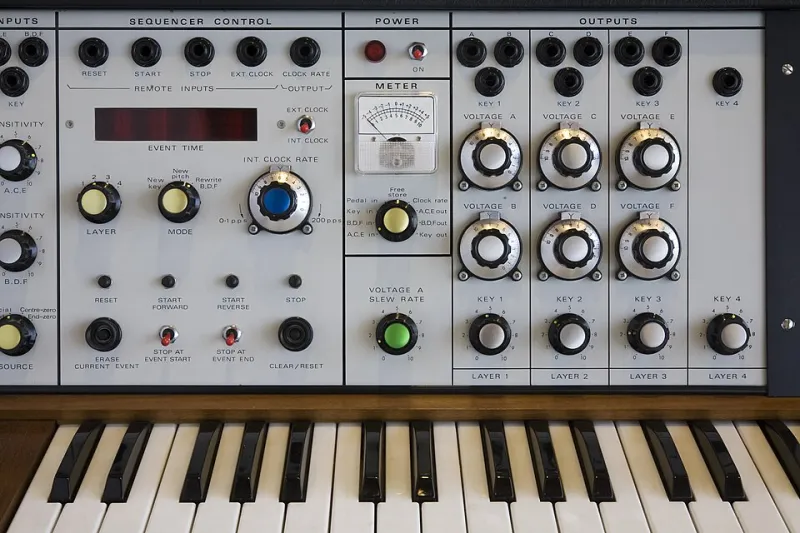
When you hear the 808 drum machine at the center of modern music, you're hearing a piece of equipment that was designed with electronic music in mind but got adopted by funk and hip-hop producers who heard something in it that its creators hadn't fully imagined. That's the funk diaspora in action — a sound gets picked up, reimagined, and returned in a form that changes everything.
France's Love Affair With the Groove
France deserves its own paragraph because the French relationship with American funk and soul has been long, serious, and genuinely influential. Paris in the 1980s and 1990s had a thriving funk and soul scene that was pulling from American records and building something distinctly its own. The producers who came out of that world — Daft Punk being the most famous example — were essentially funk archivists who decided to make new records instead of just playing old ones.
Daft Punk's "Get Lucky" wasn't a nostalgia exercise. It was a thesis statement about what funk means and where it was going. Nile Rodgers, an architect of American funk's disco-era peak, playing guitar on a French electronic duo's record, becoming a global hit in 2013 — that's the diaspora completing a full loop in real time, on a massive stage.
The less famous version of this story involves dozens of French producers who spent years sampling and reconstructing American funk records, developing an ear for the music that in some cases exceeded what was happening in the US at the same moment. That knowledge flowed back across the Atlantic through collaborations, through samples, through the simple fact that American artists were paying attention.
What Comes Home Isn't What Left
Here's the thing about cultural exchange at this level: it doesn't work like a boomerang. The funk that comes back to American artists through Brazilian producers, Japanese collectors, German electronic music, and French sampling culture isn't the same funk that left. It's been through something. It carries new information.
Contemporary US artists working in funk-adjacent spaces — Thundercat, Kaytranada, Cory Henry, Silk Sonic — are drawing on a version of the tradition that has already been around the world. They're not just inheriting James Brown and Parliament-Funkadelic directly. They're inheriting a global conversation about what those artists meant and what their music could become.
That's not dilution. That's evolution. And it's exactly what funk has always done — take what's available, transform it through the specific gravity of a particular place and moment, and hand it forward to whoever's next.
The groove didn't go global and lose itself. It went global and found out how many different ways there were to be exactly what it already was.